What Is the Oldest Extreme Sport in the World?
 Dec, 8 2025
Rugby's Historical Timeline: Oldest Extreme Sport
Rugby's Evolution Timeline
Modern Rugby vs. Other Extreme Sports
Concussion rates per 1,000 playing hours:
Protective gear usage:
When you think of extreme sports, you probably picture skydiving, skateboarding, or big-wave surfing. But the oldest extreme sport in the world isn’t new-it’s older than most modern nations. It’s not done on a halfpipe or a mountain ridge. It’s played on muddy fields, with men tackling each other like thunder, no helmets, no padding, and no mercy. That sport is rugby.
Rugby isn’t just a game-it’s a survival test
Rugby started as a raw, chaotic version of football played in English schools in the early 1800s. But its roots go deeper. The earliest forms of ball games involving carrying, tackling, and scoring by grounding the ball date back over 2,000 years to ancient Greece and Rome. The Greek game episkyros and the Roman harpastum were brutal, team-based, full-contact sports. Players used hands and feet, fought for possession, and aimed to force the ball across a line. Sound familiar?
Unlike modern soccer or American football, these ancient games had no rules, no referees, and no limits. Teams could be dozens strong. Matches lasted hours. Injuries were common. Death wasn’t unheard of. This wasn’t recreation-it was a test of strength, endurance, and will. That’s the definition of extreme sport: physical risk, high intensity, and minimal safety gear.
The moment rugby became rugby
The story most people know begins in 1823 at Rugby School in England. Legend says a student named William Webb Ellis picked up the ball during a football match and ran with it. Whether it’s true or not, the story stuck. What’s real is that by the 1840s, Rugby School had codified a version of football that allowed handling the ball and tackling. Other schools copied it. By 1871, the Rugby Football Union was formed in England-the first official body for any football code.
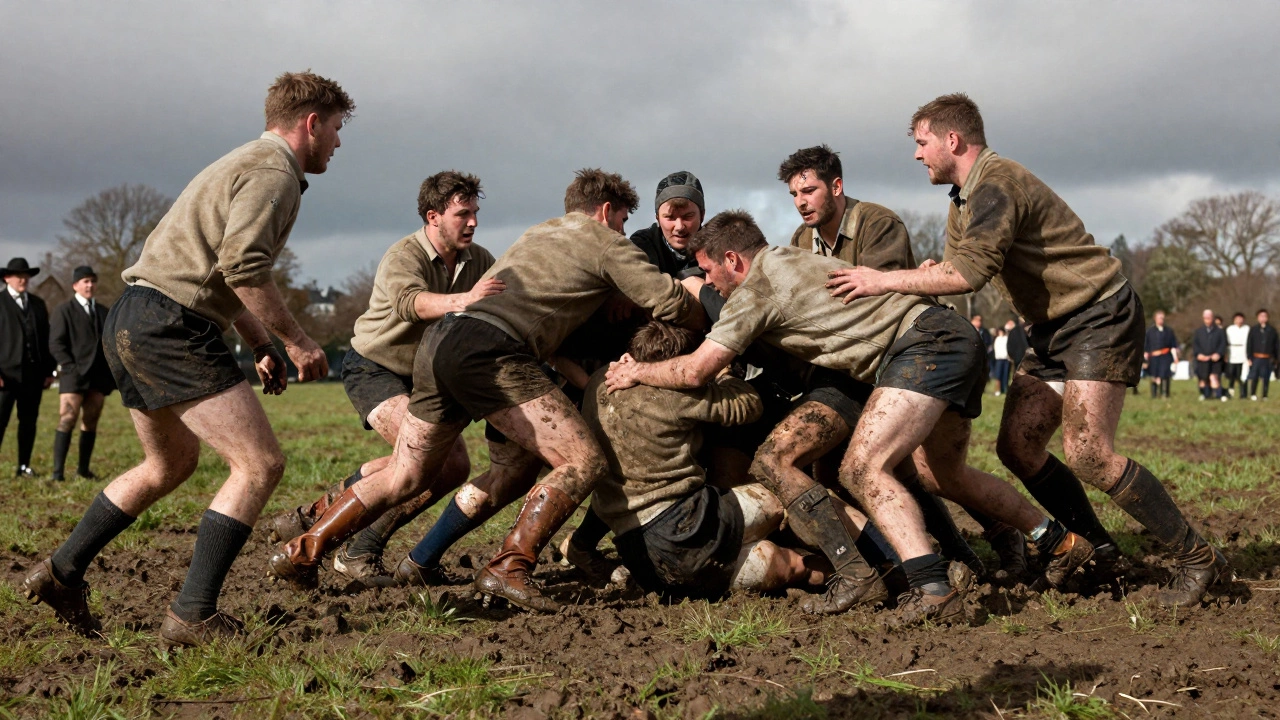
What made it extreme? Players wore leather boots, wool shirts, and sometimes caps. No mouthguards. No shoulder pads. No helmets. Tackles were full-body, often from the side or behind. Scrums were literal piles of 8 men pushing with their shoulders, trying to win the ball. Broken ribs, dislocated shoulders, and concussions were part of the game. There was no substitute rule. If you were down, you stayed down. The game didn’t stop for injuries.
In 1888, the first British Lions tour went to New Zealand and Australia. The matches were brutal. Local players, many of them Māori and Aboriginal, brought their own physicality. The game evolved into something even tougher. By the 1900s, rugby was played across the British Empire-from South Africa to Fiji to Japan. Each region added its own flavor, but the core remained: high impact, low protection, maximum grit.
Why rugby beats other ‘extreme’ sports for age
Some might argue that skateboarding, BMX, or snowboarding are extreme. They’re not even close in age. Skateboarding started in the 1950s. Snowboarding didn’t exist until the 1960s. Even rock climbing as a sport only became popular in the 1970s. Rugby? It’s been played in recognizable form for over 150 years. Its ancestors? Over two millennia old.
Compare that to modern extreme sports. They rely on technology-boards, harnesses, safety gear, airbags. Rugby? It thrives on raw human power. There’s no gear to hide behind. No safety net. The field is the only barrier. That’s why it’s extreme. Not because it’s flashy. Because it’s primal.
Modern rugby still carries the edge
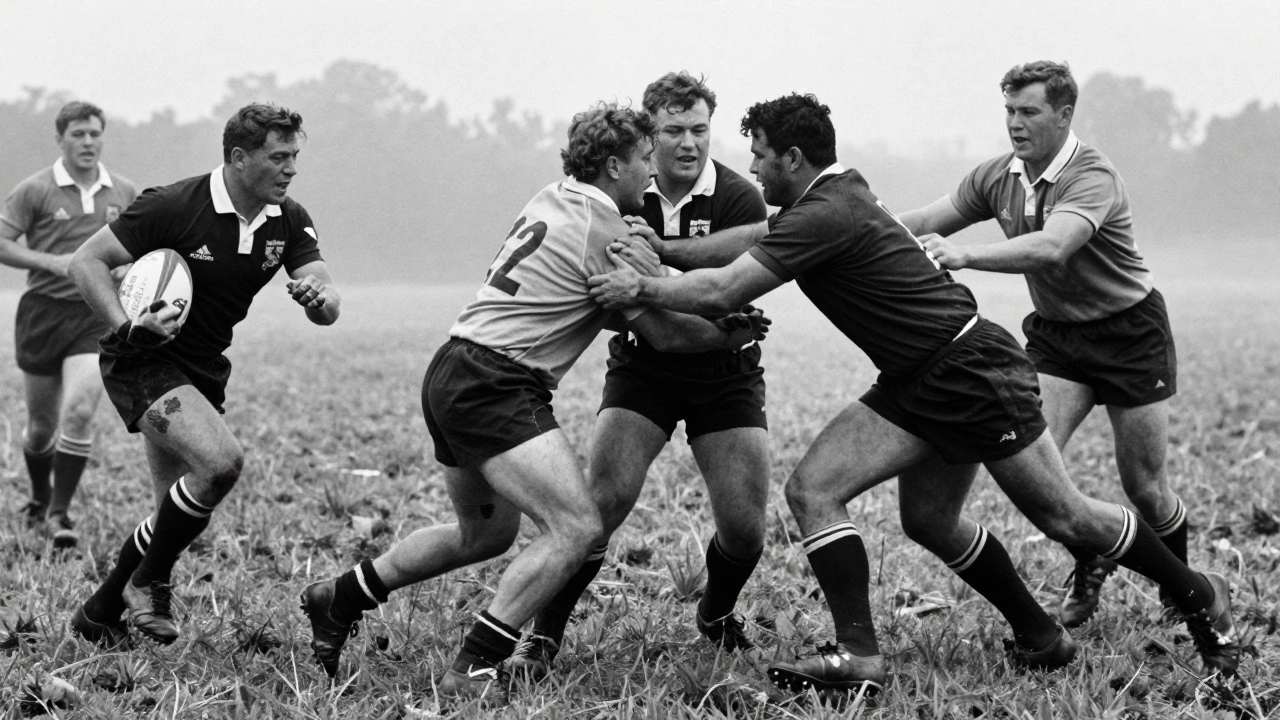
Today’s professional rugby is faster, more tactical, and better coached. But it hasn’t lost its edge. In the 2023 Rugby World Cup, players averaged 120 tackles per match. The highest-speed runs reached 37 km/h. Collisions hit forces over 1,500 Newtons-equivalent to being hit by a small car moving at 10 km/h.
Concussion rates remain high. In 2024, a study by the International Rugby Board found that elite players face a 1 in 5 chance of suffering a concussion over a single season. That’s higher than in American football. And while helmets are now allowed, they’re optional. Most players still choose not to wear them. Why? Because they feel they hinder vision and mobility. They’d rather risk injury than lose performance.
Even at the grassroots level, schoolboys and village teams play with the same ferocity. In rural Wales, teams still play on frozen fields in December. In Fiji, kids grow up playing rugby barefoot on coral rock. In Japan, the All Blacks face teams that train on rice paddies turned mud pits. The sport hasn’t been sanitized. It’s been refined-but never tamed.
What makes rugby the true extreme sport
Extreme sports are defined by risk, adrenaline, and physical mastery. By those standards, rugby wins by default. It’s the only sport that combines:
- Full-contact tackling without protective gear
- Continuous play for 80 minutes with minimal breaks
- High-speed collisions at elite levels
- Historical roots stretching back to ancient civilizations
- Global participation without corporate sponsorship being the main driver
No other sport has survived this long with this much rawness. Boxing? It’s one-on-one. Rock climbing? It’s solo. Surfing? It’s nature-dependent. Rugby? It’s human against human, on your terms, in any weather, with no escape.

It’s not just a sport-it’s a cultural force
Rugby isn’t played in stadiums alone. It’s woven into national identity. In New Zealand, the haka before a match isn’t performance-it’s ancestral power. In Georgia, rugby is called the national religion. In Samoa, players train with pigs and coconuts before matches. In South Africa, the 1995 World Cup win didn’t just bring a trophy-it helped heal a nation.
These aren’t traditions added for show. They’re survival rituals. The game demands loyalty, courage, and sacrifice. That’s why it’s endured. Not because it’s safe. Not because it’s easy. But because it’s real.
Why people still play it
Why do thousands of teenagers in Australia, Tonga, and Argentina still run into each other headfirst on muddy fields? Because rugby gives you something no video game or treadmill can: proof of your limits. You learn what you’re made of when your shoulder hits a 110-kilo man at full speed and you don’t fall. You learn teamwork when you’re the last man standing and your team needs one more meter. You learn respect when you shake hands with the guy who just broke your nose.
Rugby doesn’t ask if you’re brave. It shows you.
Is rugby the oldest contact sport in the world?
Yes, in its modern organized form, rugby is the oldest contact sport with continuous global play since the 19th century. Its direct ancestors, like the ancient Greek episkyros and Roman harpastum, date back over 2,000 years. No other team sport combines full-contact play, handling the ball, and continuous action with such deep historical roots.
Was rugby always played with 15 players per side?
No. Early versions of rugby at Rugby School had no fixed team size-teams could range from 20 to 30 players. The 15-a-side format was standardized in 1877 by the Rugby Football Union. Later, in 1907, a faster version called rugby league emerged with 13 players. Today, both versions are played worldwide, but 15s remains the Olympic and World Cup format.
Do modern rugby players wear any protective gear?
Modern players can wear soft headgear (scrum caps), mouthguards, and padded shirts-but they’re not required. Most elite players avoid helmets because they restrict vision and movement. Mouthguards are worn by over 90% of professionals, but headgear is only used by about 30%. The sport still values toughness over protection.
How does rugby compare to American football in terms of danger?
Both sports carry high injury risks, but rugby has higher concussion rates per hour of play. A 2024 study found rugby players suffer 4.2 concussions per 1,000 playing hours, compared to 3.1 in American football. Rugby also has more frequent non-contact injuries due to tackles and rucks. However, American football has more catastrophic spine and neck injuries because of high-speed helmet-to-helmet collisions.
Why hasn’t rugby become as popular as soccer or American football?
Rugby’s physical intensity and lack of stoppages make it harder to broadcast and monetize. It doesn’t have timeouts, commercials, or instant replays built in. Also, it never had the same level of corporate investment as soccer or American football. But in countries like New Zealand, Fiji, and Georgia, it’s the most popular sport. Its global growth is slow but steady-especially in Asia and South America.
Final thought: It’s not about the sport-it’s about the spirit
If you want to know why rugby is the oldest extreme sport, don’t look at the rules. Look at the players. Look at the guy who gets up after a tackle that left him dizzy, wipes mud from his eyes, and runs back into the scrum. Look at the teenager in a village in Samoa who plays with no boots, no coach, and no future except the game. That’s what makes it extreme. Not the speed. Not the force. The fact that people still choose it-despite the cost.
Rugby didn’t invent extreme. It inherited it-from ancient battlefields, from tribal rituals, from the need to prove you’re alive. And it still carries that fire today. No other sport does.