What Is 5-3-1 in Gym? The Simple Strength Training System That Works
 Mar, 8 2026
5-3-1 Strength Training Weight Calculator
Calculate Your 5-3-1 Weights
Your 5-3-1 Program
Your Recommended Weights:
- Week 1: lbs
- Week 2: lbs
- Week 3: lbs
- Week 4: lbs
Ever walked into a gym and heard someone say they're doing 5-3-1? Maybe you’ve seen it on a whiteboard or in a forum and thought, ‘What does that even mean?’ It’s not a secret code or a weird math problem-it’s one of the most effective, no-fluff strength training systems out there. And if you’ve been stuck in endless cycles of high-rep workouts or chasing muscle burn instead of real strength, this might be exactly what you need.
What Exactly Is 5-3-1?
5-3-1 is a structured strength training program created by powerlifter and coach Jim Wendler. It’s built around four main lifts: the squat, bench press, deadlift, and overhead press. The name comes from the rep scheme used each week: 5 reps, then 3 reps, then 1 rep, followed by a deload week. That’s it. No complicated charts, no guessing, no fancy equipment needed-just barbells, weights, and consistency.
The goal isn’t to get bigger muscles overnight. It’s to get stronger, safely and sustainably. You don’t need to max out every week. In fact, you’re designed to avoid that. The program uses percentages of your current one-rep max (1RM) to calculate your working weights. This keeps you progressing without burning out.
How the 5-3-1 Cycle Works
Each cycle lasts four weeks. You train three days a week-typically Monday, Wednesday, and Friday-with each day focused on one main lift. Here’s the breakdown:
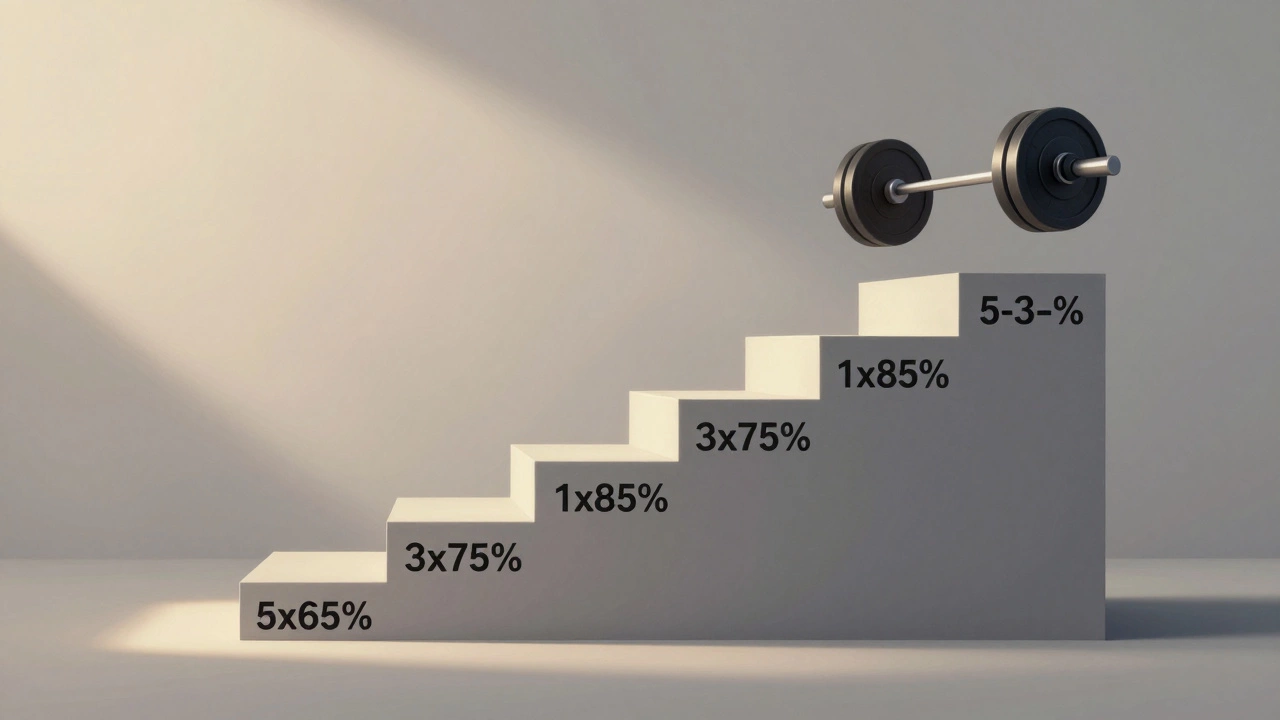
- Week 1: 5 reps at 65% of your 1RM
- Week 2: 3 reps at 75% of your 1RM
- Week 3: 1 rep at 85% of your 1RM
- Week 4: Deload-light weights, 5 reps at 40-50%
After Week 4, you repeat the cycle-but this time, you increase your 1RM based on how well you did. If you hit all your reps in Week 3, you add 5-10 pounds to your 1RM for the next cycle. If you struggled, you keep the same weight. No pressure. No guessing. Just steady progress.
For example, if your squat 1RM is 200 pounds:
- Week 1: 5 reps at 130 lbs (65% of 200)
- Week 2: 3 reps at 150 lbs (75% of 200)
- Week 3: 1 rep at 170 lbs (85% of 200)
- Week 4: 5 reps at 90 lbs (45% of 200)
That’s it. You don’t need to do 10 sets of 10 reps. You don’t need to chase failure. You just show up, lift smart, and let the system do the work.
Why 5-3-1 Works Better Than Other Programs
Most strength programs either go too hard too fast or drown you in volume. 5-3-1 avoids both. Here’s why it stands out:
- Progressive overload without burnout: The ramp-up from 5 to 3 to 1 reps gives your nervous system time to adapt. You’re not maxing out every session, so recovery stays on track.
- Deload week built-in: Week 4 isn’t optional. It’s critical. That’s when your body repairs, and your strength actually increases.
- Simple to track: You only need to know your 1RM once. After that, it’s all percentages. No apps required. Just a notebook and a calculator.
- Works for beginners and veterans: If you’ve never lifted heavy, you can start with a realistic 1RM. If you’ve been lifting for years, you can still make gains without reinventing your routine.
Compare that to programs like Starting Strength or StrongLifts 5x5. Those are great-but they demand heavy weights every session. 5-3-1 gives you breathing room. You can still do accessory work, cardio, or even play sports on off days without feeling wrecked.
How to Find Your 1RM (Without Testing It)
You don’t need to go all-out on a single rep to start 5-3-1. That’s dangerous and unnecessary. Instead, use a reliable estimation based on a set you can do with good form.
Here’s the easiest method:
- Find a weight you can lift for 5 reps with perfect form, but that feels hard on the 5th rep.
- Use this formula: Estimated 1RM = Weight × 1.167
Example: You do 150 lbs for 5 reps. Multiply 150 × 1.167 = 175 lbs. That’s your estimated 1RM. Use that to calculate your 65%, 75%, and 85% weights.
If you’ve been lifting for a while and have a recent 1RM, use that. If you’re unsure, start conservative. You’ll adjust in the next cycle.
What to Do on Accessory Days
The core of 5-3-1 is the big lifts. But you still need to build supporting muscles-especially shoulders, back, and core. That’s where accessory work comes in.
After your main lift each day, do 2-3 of these:
- For squats: Romanian deadlifts, glute bridges, lunges
- For bench press: Dumbbell presses, pull-ups, triceps pushdowns
- For deadlift: Face pulls, farmer’s carries, hyperextensions
- For overhead press: Rows, lateral raises, planks
Keep these light-3 sets of 8-12 reps. No ego lifting. The goal is to support your main lifts, not exhaust you.
Common Mistakes People Make With 5-3-1
Even though it’s simple, people still mess it up. Here’s what to avoid:
- Skipping the deload week: This is the #1 reason people burn out. That light week isn’t a break-it’s when you get stronger.
- Adding too much weight too fast: If you missed reps in Week 3, don’t jump +15 lbs. Stick to +5 or even stay the same. Patience wins.
- Trying to max out every week: You’re not trying to hit personal records every session. You’re building a foundation. The big gains come later.
- Ignoring form: The weights aren’t that heavy at first. If you’re struggling with form, reduce the weight. Strength means control, not momentum.
Who Is 5-3-1 Best For?
It’s not for everyone-but it’s perfect for:
- Someone who’s plateaued after months of high-rep workouts
- A beginner who wants to build real strength without getting overwhelmed
- An intermediate lifter who’s tired of guessing what to lift
- Anyone who wants to get stronger without spending 2 hours in the gym
If you’re training for endurance, bodybuilding, or sports performance with high volume, 5-3-1 might not be your only program-but it’s still a powerful tool to add in. Many athletes use it during off-seasons to build a strength base.
Real Results: What People Actually Gain
One guy I know, a 38-year-old teacher, started 5-3-1 with a 135 lb squat. After three cycles (12 weeks), he hit 225 lbs. He didn’t change his diet. He didn’t take supplements. He just showed up, followed the numbers, and let the system work.
Another woman, a nurse who’d never lifted before, started with a 95 lb bench. Six months later, she was pressing 135 lbs. She said, ‘I didn’t think I’d ever lift more than my purse.’
These aren’t outliers. They’re people who stuck with a simple plan. No magic. Just consistency.
Final Thoughts: Why This Isn’t Just Another Program
Most strength programs promise results. 5-3-1 delivers them without the hype. It doesn’t ask you to train 6 days a week. It doesn’t require expensive gear. It doesn’t demand you become a gym rat. It just asks you to lift smart, recover well, and trust the process.
If you’ve been trying everything and nothing sticks, give 5-3-1 a shot. Start with your current 1RM. Follow the reps. Do the deload. Wait a few weeks. Then look back. You’ll be surprised how much stronger you’ve gotten-without even trying to.
Do I need to test my 1RM to start 5-3-1?
No. You can estimate your 1RM using a 5-rep max and multiplying by 1.167. Testing a true 1RM isn’t necessary and can be risky if you’re not experienced. Start conservatively and adjust after each cycle.
Can I do 5-3-1 if I’m a beginner?
Absolutely. In fact, beginners often benefit the most. The program teaches control, consistency, and progressive overload-all without overwhelming volume. Start with light weights, focus on form, and let the percentages guide you.
How long should I follow 5-3-1?
There’s no deadline. Many people stay on it for months or even years. It’s designed to be sustainable. You can cycle through it repeatedly, increasing your 1RM each time. Some lifters use it as their main program for years.
What if I miss a rep in Week 3?
Don’t panic. If you missed your 1-rep attempt, keep your 1RM the same for the next cycle. Progress isn’t linear. Strength builds over time, not in single sessions. Stay patient and consistent.
Can I add cardio or other workouts while doing 5-3-1?
Yes. In fact, light cardio on off days helps recovery. Just avoid high-intensity sessions right before or after your main lifts. Keep it moderate-walking, cycling, or swimming work well. The goal is support, not exhaustion.
If you’ve been looking for a strength program that actually works without burning you out, 5-3-1 is your answer. No gimmicks. No hype. Just clear, repeatable progress. Start this week. Track your lifts. And let the numbers do the talking.