Why Is It Called Par in Golf? The History and Meaning Behind the Term
 May, 23 2026
Golf Score & Terminology Calculator
Enter Your Scores
| Hole | Par | Your Strokes | Result | Term |
|---|
Have you ever stood on the first tee, watched your friend sink a putt, and heard someone shout, "That's par!" without really knowing why that specific word was chosen? It feels like an odd term for a sport. We don't say "standard" or "average." We say "par." It’s short, punchy, and deeply embedded in the culture of the game. But where did it come from? Why not just call it "two putts" or "fair play"?
The answer isn't as simple as pointing to a single golfer in the 19th century who decided to rename the scorecard. Instead, the story of "par" is a mix of French etymology, British aristocracy, and the evolution of how we measure skill in sports. Understanding this helps you appreciate the game more, not just as a set of rules, but as a living history.
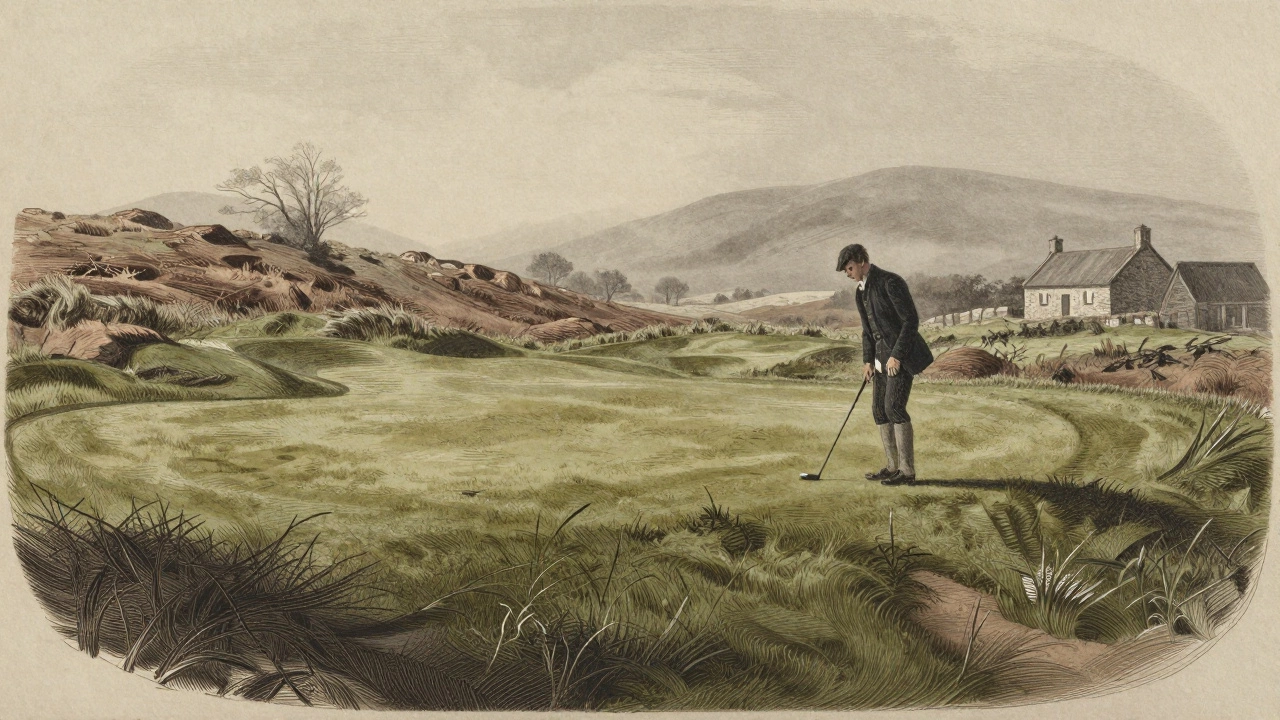
Before we dig into the dictionaries, let's look at how the game was scored before "par" existed. In the early days of golf, particularly in Scotland during the 18th and early 19th centuries, courses didn't have standardized lengths. A hole might be 200 yards one day and 350 yards the next, depending on where the green was cut. Because of this variability, there was no fixed number of shots expected for each hole. Players often played for "money golf," betting on each shot, rather than trying to beat a course standard.
What does 'par' actually mean in English?
In general English, 'par' comes from the French word 'pair,' meaning equal or level. It signifies a standard benchmark against which other things are measured. For example, selling stock at 'par value' means selling it at its face value, neither more nor less.
The French Connection: From 'Pair' to 'Par'
To understand "par," you have to look at its linguistic roots. The word enters English via Middle French, derived from the Latin paris, meaning equal. You see this root in words like "parity" (equality) and "parameter" (a defining characteristic). In financial contexts, if a bond trades at par, it trades at its face value. It is the baseline.
Golf borrowed this concept of a "baseline" or "equal standard." But it wasn't always used that way. In the mid-19th century, the term "par" appeared in golf literature, but it meant something slightly different than it does today. It referred to the maximum number of strokes allowed for a hole in certain handicap formats. If you exceeded par, you were penalized. It was a limit, not a target.
This distinction matters because it shows how the language of golf evolved alongside the structure of the tournaments. As golf moved from casual match play to stroke play competitions, organizers needed a way to compare scores across different courses and conditions. They needed a universal constant. That constant became "par." The Royal and Ancient Golf Club of St Andrews is the oldest golf club in the world, founded in 1754, which played a pivotal role in standardizing golf rules and scoring terminology. Their influence helped cement 'par' as the standard metric for course difficulty.
If you're interested in exploring other aspects of leisure and travel culture, you might find interesting resources online. For instance, some people look for directories when traveling to exotic locations; for example, this directory lists various companions in Dubai, showing how niche services organize themselves much like golf clubs organize their handicaps.
The Shift from Bogey to Par
Here is where it gets interesting. Before "par" became the dominant term, golfers used a different word entirely: "bogey." Yes, the monster under the bed, but also a scoring term. Where did that come from? It comes from a popular British music hall song from the late 19th century called "Sally Gardens," which featured a character named "The Bogey Man."
Golfers adopted "the bogey man" as the ideal player they were trying to beat. If you shot the score of the "bogey man," you were doing well. Over time, "bogey" shortened to just "bogey." So, for decades, the standard score for a hole was called a bogey. A "par" was actually considered a very good score, often one stroke better than the bogey.
This creates a confusing timeline for modern readers. In the early 1900s:
- Bogey: The expected score for a competent amateur.
- Par: A theoretical perfect score, usually one stroke better than bogey.
- Mahogany: Two strokes worse than bogey (named after the wood, implying it was hard to achieve).
So, if you read old golf archives, you'll see players boasting about shooting "par" when they were actually performing exceptionally well, far below the average. The term "par" was aspirational. It represented equality with the course designer's vision, assuming perfect play.
Standardization and the Modern Definition
By the 1920s and 1930s, golf courses were being built with more precision. Architects like Donald Ross and Alister MacKenzie began designing holes with specific lengths and hazards in mind. They knew exactly how many shots a skilled player should need to complete each hole. This architectural certainty required a scoring system that reflected design intent, not just average performance.
The United States Golf Association (USGA) and The R&A began formalizing the definition of par. They defined it as the number of strokes an expert golfer should require to complete a hole, including two putts per green. This removed the ambiguity of the "bogey man" and tied the score directly to the physical layout of the course.
| Term | Relation to Par | Origin/Meaning |
|---|---|---|
| Hole-in-One | -3 (on a Par 4) | One stroke to complete the hole |
| Eagle | -2 | Named after the bird of prey, extending 'birdie' |
| Birdie | -1 | Slang for 'excellent,' originating in 1899 |
| Par | 0 | French 'pair,' meaning equal or standard |
| Bogey | +1 | From the 'Bogey Man' song, representing the ideal player |
| Double Bogey | +2 | Two strokes over the standard |
This shift solidified "par" as the central axis of golf scoring. Everything else is measured relative to it. Birdies and eagles are below par; bogeys and double bogeys are above. This symmetry makes the math of golf intuitive. You can instantly calculate your total score by counting deviations from par, rather than adding up every single stroke. This efficiency is crucial for tournament broadcasts and leaderboard tracking.
How Par is Assigned to Holes
You might wonder, who decides what par is for a specific hole? It's not arbitrary. Course raters, certified by governing bodies like the USGA, evaluate each hole based on length and difficulty. Here is the general rule of thumb for men's tees:
- Par 3: Up to 250 yards. These are short holes where the goal is to reach the green in one shot and two-putt.
- Par 4: 251 to 470 yards. Requires a drive, an approach shot, and two putts.
- Par 5: 471 yards and longer. Allows for three shots to reach the green, plus two putts.
- Par 6: Rare, usually over 670 yards. Designed for elite professionals or very long courses.
Women's tees have different distance standards, typically shifting these ranges down by 100-150 yards. A hole that is a Par 4 for men might be a Par 5 for women if the distance exceeds the comfortable range for an average female golfer to reach in two shots.
It's important to note that par doesn't account for wind, rain, or fast greens. It assumes neutral conditions. This is why your personal "par" might feel higher on a windy day at a links course in Scotland compared to a calm morning in Florida. The course rating adjusts for difficulty, but par remains a static benchmark based on design.
Why the Term Stuck
Language evolves through usage, and "par" stuck because it is efficient. It is a single syllable. It fits easily into conversation. "I shot even par" is quicker to say than "I shot the standard expected score." Moreover, it connects golf to broader concepts of fairness and equality. Playing to par implies playing fairly, adhering to the intended challenge of the course.
The term also resonates with the strategic nature of golf. Unlike running or swimming, where faster is always better, golf requires risk management. Sometimes, aiming for par is the smartest move. Hitting a safe iron to the center of the green to secure a par is often wiser than driving for the pin and risking a double bogey. The word "par" embodies this balance between ambition and prudence.
Common Misconceptions About Par
Many beginners believe that par is the average score of all golfers. This is incorrect. The average score for a recreational golfer is often significantly higher than par, frequently around 90-100 for an 18-hole course. Par is designed for experts. If you shoot par, you are playing at a professional level.
Another misconception is that par changes based on your skill level. Your handicap adjusts for your skill, but the course par remains fixed. A beginner and a pro play the same par 4. The difference lies in their ability to execute the shots required to meet that standard.
Is par the same as the course rating?
No. Par is the number of strokes an expert golfer should take. Course Rating is the expected score for a scratch golfer (handicap 0) under normal conditions. Course Rating often differs slightly from par due to factors like rough thickness, bunker depth, and green speed.
Why is a score of -1 called a birdie?
The term 'birdie' originated in 1899 at the Atlantic City Country Club. Golfer Ab Smith hit a shot so good he said it was a 'bird.' His friends encouraged him to use 'birdie' for one under par. The slang 'bird' meant excellent or cool in American English at the time.
Can a hole have a par of 1?
Technically, yes, but it is extremely rare. Most Par 3s are long enough that even pros rarely hole out. A Par 1 would imply a hole so short that an expert could almost always sink it in one shot, which defeats the purpose of a challenging golf course.
Did Tiger Woods change the meaning of par?
No, Tiger Woods did not change the definition of par. However, his dominance in the late 1990s and 2000s raised the competitive bar. Tour averages dropped closer to par, making the term more relevant in discussions of elite performance. He made shooting par look easy, which influenced public perception of the standard.
What is the lowest possible par for an 18-hole course?
The lowest practical par for an 18-hole course is 60, consisting of eighteen Par 3 holes. While such courses exist, they are unusual. Standard courses usually have a par between 70 and 72, balancing variety and challenge.
Conclusion: More Than Just a Number
Understanding why it is called "par" adds a layer of depth to every round you play. It reminds you that you are participating in a tradition that spans centuries, rooted in language, architecture, and human competition. Next time you step onto the tee, remember that "par" is not just a target. It is a historical artifact, a mathematical benchmark, and a symbol of the game's enduring appeal. Whether you shoot par, bogey, or eagle, you are engaging with a system refined over generations to measure skill, strategy, and spirit.